
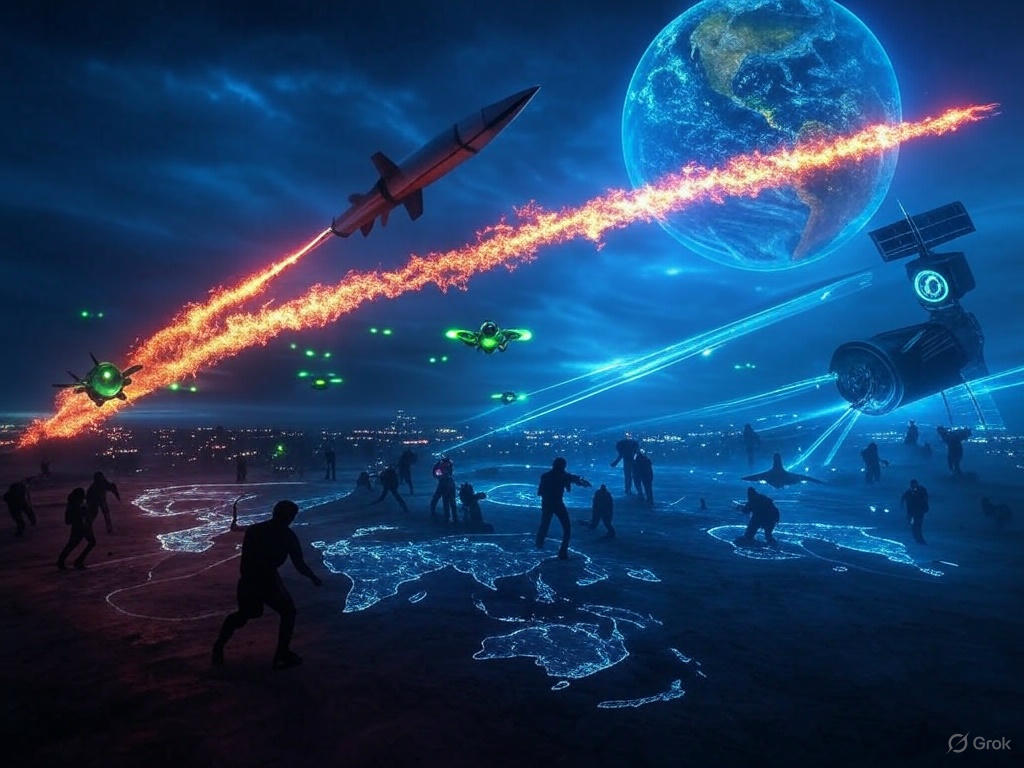
In 2025, the world’s superpowers are locked in a clandestine race to unveil secret military technologies that could redefine warfare. From the United States to China, Russia to India, nations are pouring billions into military tech 2025, shrouded in secrecy yet poised to shift the global balance of power. Fueled by escalating tensions—like China’s AI chip breakthroughs (March 24, 2025)—these secret military technologies blend artificial intelligence, hypersonic speed, and space dominance into a new era of conflict. Here’s what’s brewing behind closed doors and why it matters in the global arms race.
AI-Powered Warfare: The Brain of Military Tech 2025
Artificial intelligence (AI) tops the list of secret military technologies in 2025. The U.S. Navy’s “Project 33” aims to deploy AI co-pilots in combat jets, predicting enemy moves in real-time, while China’s DeepSeek V3 upgrade (March 24) hints at AI-driven drones that outsmart human pilots. These advanced defense systems analyze massive data streams—think satellite feeds or battlefield chatter—faster than any general. Nations keep specifics under wraps, but whispers on X suggest AI could autonomously launch strikes by 2030, raising ethical stakes in the global arms race.
Hypersonic Weapons: Speed Redefines Emerging War Tech
Hypersonic missiles, clocking over Mach 5, are a cornerstone of secret military technologies in 2025. Russia’s Avangard system already terrifies NATO, but the U.S.’s ARRW program and China’s rumored DF-ZF upgrades are catching up. These advanced defense systems dodge traditional missile shields, striking targets with pinpoint precision in minutes. Leaked tests (e.g., Missile Defense Agency, 2022) show lasers countering them, but nations hide deployment details, fueling a military tech 2025 sprint that could render current defenses obsolete.
Space-Based Domination: The Next Frontier of Secret Military Technologies
Space is no longer sci-fi—it’s a battleground for secret military technologies. By 2025, the U.S. Space Force and China’s satellite-killer programs are testing anti-satellite weapons and quantum-encrypted comms. A digital globe where BRICS nations glow brighter than fading U.S. cities (think March 27 imagery) isn’t far off. These emerging war tech tools—hidden from public budgets—promise missile detection from orbit and cyberattacks via hacked satellites, reshaping the global arms race beyond Earth.
Cyber Warfare: Invisible Advanced Defense Systems
Cyber isn’t loud, but it’s lethal among secret military technologies. The U.S. Cyber Command’s 6,000-strong team (elevated 2017) now deploys AI to cripple enemy grids, while China’s domestic chip push (March 24) shields its networks from sanctions. Russia’s misinformation bots and deepfake ops, refined by 2025, blur truth on X—think AI voices faking orders. These advanced defense systems, veiled in code, could crash economies or spark wars without a shot fired.
Why It Matters: The Stakes of Military Tech 2025
The secret military technologies of 2025 aren’t just gadgets—they’re power. Nations like India (naval drones) and NATO allies (DIANA’s 44 startups) race to innovate, but secrecy breeds uncertainty. Will AI ethics lag? Can hypersonics be countered? As the global arms race heats up, emerging war tech promises dominance—or chaos—for those who crack it first.